For thousands of years, we’ve recognised that surrounding ourselves with nature can invigorate our minds and bodies. Heavenly natural settings featured in ancient religious texts, the Romans dedicated large parts of their cities to green spaces, and medieval monasteries centred on healing gardens.
And when we couldn’t be outside, we tried to bring nature into our homes.
A Rich History
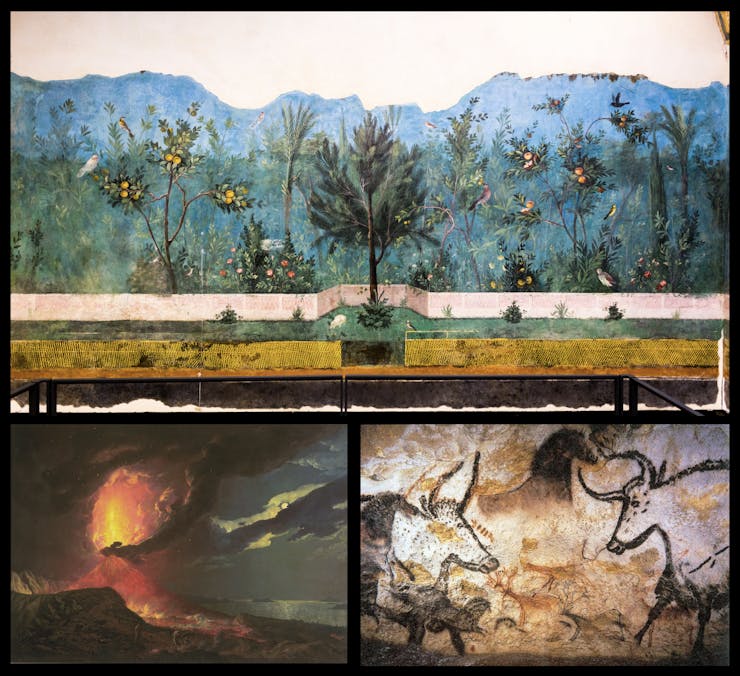
Palaeolithic artists painted natural scenes and wild creatures onto the walls of their caves, the Greeks and Romans adorned their villas with frescoes of gardens and orange groves, and Romantic era artists painted volcanoes, violent seas, and vibrant sunsets.
We even tried to make these experiences multisensory: performers in the middle ages imitated bird song, classical composers mimicked the sounds of rain, thunder, and songbirds in their concertos, and early 20th century field recordists brought ‘natural ambience’ into people’s homes like never before.
For as far back as we can tell, we have missed nature when we’re not in it, and tried to embody the experience of ‘being there’ by whatever means lay at our disposal.
The Science
Over the last few decades, an established body of scientific evidence has confirmed what our ancestors suspected: nature has the power to transform our wellbeing. When people are immersed in the natural world they feel more positive, recover faster from stress, become more curious and creative, and even act kinder to the people around them.
A Spectrum of Contact
Academics often talk about a spectrum of possible contact with nature. At one end of this scale is the full, unfettered, immersive experience – think swimming in the sea or walking barefoot on a beach. In the middle of the scale we might find cycling along a canal path on the way to work – a quick but often unintentional brush with nature. And at the other end of the spectrum lies ‘indirect’ forms of contact, such as those ancient cave paintings and frescoes, and modern digital forms of nature.
These types of encounters are sensorily very different from one another, yet they each play a vital part in our ‘personal ecology’ – the way we interact with and learn about nature on a daily basis. Our personal ecology is constantly changing, day by day, season by season. Sometimes we might struggle to get outside because of work or the weather. At other times we might find ourselves in nature for hours or even days at a time. For many people, these routines will evolve over their lives due to changing commitments, health, or mobility. Digital forms of nature are an important component in this mix, often without us realising – take for example the 10 million people (15% of the UK population) who tuned into the first episode of the BBC’s Planet Earth III series to get their nature fix at home. We’re increasingly understanding that this kind of experience might bring some of the benefits of nature to people when life gets in the way and they’re stuck indoors.
Digital by Design
And modern humans spend a lot of time indoors. A now famous study from 2001 showed that in the United States, people spend roughly 90% of their time in ‘enclosed buildings’.
On top of that, over the last twenty years we have seen a tectonic shift towards a human culture that is digital: the average American adolescent now spends nine hours a day in front of a screen whilst in the UK, over 90% of children own a smartphone by the time they’re eleven. So not only are people inside a lot, but that time is now largely dedicated to virtual and online spaces.
But it turns out that a large proportion of the evidence explaining how people respond to the natural world is actually based on these kinds of digital experiences. Researchers often have to conduct their studies in the laboratory, and in these situations virtual forms of nature are considered a valid replacement for the ‘real thing’. This approach is so common that two recent reviews found over 180 published studies that used simulated forms of nature to reduce stress and mental fatigue in their participants.
These experiments have shown that digital tools can be a powerful way to bring the benefits of nature to indoor environments. And there’s more: virtual experiences might offer additional benefits by bringing us closer to habitats that we might rarely see and hear, helping to trigger powerful emotions such as awe and wonder, and even deepening our connection with nature.
A New Kind of Encounter
These are the outcomes we’re most excited by and again, history has some important lessons for us.
In the 1890s, the pioneering nature-writing of John Muir gave birth to the North American love of wilderness – yet people reading his books were connecting to landscapes most of them had never visited. And over the last century, cultural geographers have shown that so much of the memory and meaning that bonds us to different environments is not only imbued in situ, but by the rich forms of storytelling that both traditional and modern digital media can offer. These insights can be immensely powerful for how people respond to nature. For example, the first release of humpback whale songs in the 1970s sparked a shift in public understanding that ultimately led to an international ban on commercial whaling. The advent of internet-based nest cameras has offered insights into the lives of urban birds that few city-dwellers have seen before, providing new opportunities for conservation and engagement. And time lapse photography is revealing the intelligent, adaptive, and often predatory behaviour of plants, helping people to appreciate their contribution to ecosystem health and tackling conservation issues such as ‘plant blindness’.
Nurturing a Connection
By offering insights into natural environments both near and far, common and exotic, serene and dramatic, we’re hoping that Portal can help to bring some of that experience – and its benefits – into our homes and workplaces, encouraging a curiosity and wonder that brings humans and nature closer together.
For us, this is where the real power of digital nature lies: not in trying to replicate or replace experiences in the real world, but in providing complementary encounters that nurture empathy and caring for the natural world. And it seems that academics agree, with some suggesting that instead of being viewed as inferior to in situ contact with nature, digital experiences should be considered a new and exciting kind of encounter in their own right. And crucially, with people across the planet spending an average of 6.5 hours a day in front of a screen – a trend that has been linked with poorer mental health – bringing nature home could be more important than ever.